VPN Basics: What It Does and What It Cannot Do
Quick summary: A virtual private network creates an encrypted connection between your device and a VPN server. It can improve privacy in some situations, but it is not a complete security solution.
A virtual private network creates an encrypted connection between your device and a VPN server. It can improve privacy in some situations, but it is not a complete security solution.
This guide explains the most important actions in a practical order. Focus on measures that reduce real risk, are easy to maintain, and fit the way your household uses technology.
What a VPN Protects
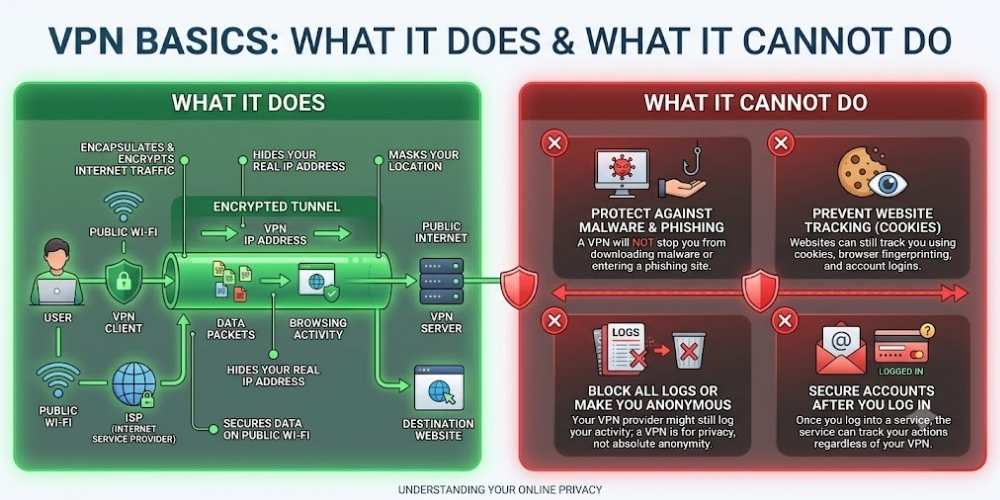
A VPN can prevent the local network operator from easily seeing the websites you visit and can hide your public IP address from destination sites.
This is especially useful on public Wi-Fi or networks you do not fully trust.
What a VPN Does Not Protect
A VPN does not stop phishing, malicious downloads, account theft, or tracking after you log in to a service.
It also does not make unsafe behavior anonymous or eliminate the need for secure browsing habits.
Choosing a Trustworthy Provider
Review the provider’s ownership, privacy policy, logging practices, security history, and independent audits.
Avoid relying only on marketing claims such as military-grade encryption.
Using a VPN at Home
A home VPN can reduce visibility for an internet provider, but the VPN company becomes a new party that handles connection metadata.
Choose carefully and keep the VPN app updated.
Using a VPN on Public Wi-Fi
Connect to the VPN before accessing sensitive accounts. Verify that the network itself is legitimate because attackers can create fake hotspots.
Prefer mobile data for highly sensitive tasks when possible.
Key Takeaway
Security improves when simple protections are applied consistently. Keep systems updated, limit unnecessary access, use strong account protection, and review settings whenever devices or household needs change.
Frequently Asked Questions
Does a VPN make me anonymous?
No. A VPN can improve privacy but does not provide complete anonymity, especially when you log in to identifiable accounts.
Should a VPN always be turned on?
Many users leave it on for convenience, but performance and access restrictions may vary. Use it whenever the network is untrusted.
Can a free VPN be safe?
Some are legitimate, but free services may have limited resources or unclear business models. Evaluate ownership, logging, and security practices carefully.

Vital Morgan is a cybersecurity researcher and technology writer with a passion for digital privacy, smart home security, and online safety. He specializes in creating practical guides on VPNs, password protection, cybersecurity best practices, smart home devices, and emerging security technologies. His mission is to help readers protect their homes, devices, and personal information in an increasingly connected world.