
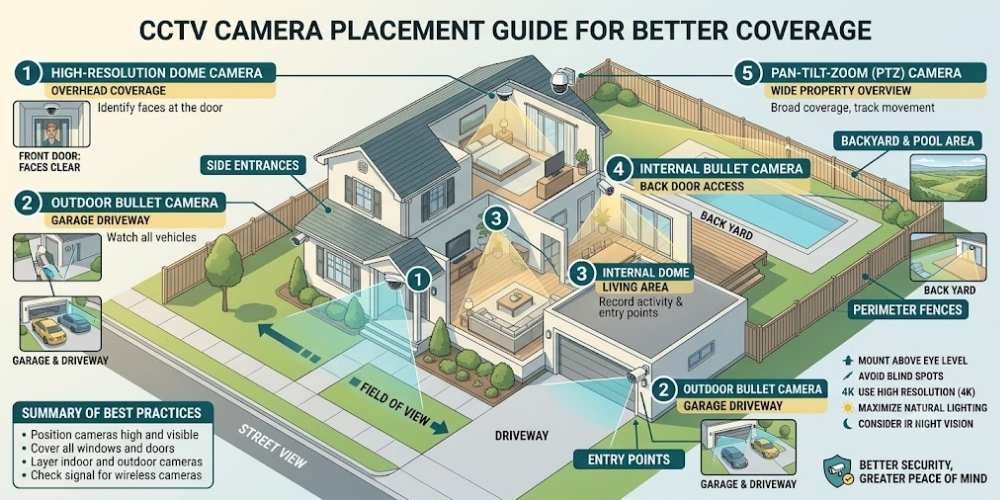
CCTV Camera Placement Guide for Better Coverage
Quick summary: Good camera placement is more important than simply buying more cameras. The goal is to capture useful evidence while avoiding blind spots, glare, and unnecessary privacy intrusion.
Good camera placement is more important than simply buying more cameras. The goal is to capture useful evidence while avoiding blind spots, glare, and unnecessary privacy intrusion.
This guide explains the most important actions in a practical order. Focus on measures that reduce real risk, are easy to maintain, and fit the way your household uses technology.
Cover Main Entry Points
Prioritize front doors, back doors, garage entrances, and ground-floor access points.
Position cameras high enough to resist tampering but low enough to capture recognizable faces.
Monitor Approach Routes
Driveways, side gates, and paths often provide earlier visibility than the door itself.
Use overlapping fields of view when one camera cannot cover the full route.
Avoid Strong Backlighting
Direct sunlight, headlights, and bright windows can reduce image quality. Test the view at different times of day.
Use cameras with suitable wide dynamic range for difficult lighting.
Respect Privacy
Avoid aiming cameras into neighboring properties, private indoor spaces, or areas where recording is restricted.
Use privacy masks when the camera software supports them.
Test Identification Quality
A wide scene may detect motion but fail to identify a face. Match lens angle, resolution, and distance to the purpose.
Review both daytime and nighttime footage before finalizing placement.
Key Takeaway
Security improves when simple protections are applied consistently. Keep systems updated, limit unnecessary access, use strong account protection, and review settings whenever devices or household needs change.
Frequently Asked Questions
How high should a home security camera be mounted?
A common range is high enough to prevent easy tampering while still capturing faces, but the exact height depends on lens and location.
Should cameras point directly at doors?
They should capture people approaching and using the door without being blocked by the door itself or strong backlighting.
Is it legal to record outside my property?
Rules vary by location. Avoid recording areas where others have a reasonable expectation of privacy and review local laws.

Vital Morgan is a cybersecurity researcher and technology writer with a passion for digital privacy, smart home security, and online safety. He specializes in creating practical guides on VPNs, password protection, cybersecurity best practices, smart home devices, and emerging security technologies. His mission is to help readers protect their homes, devices, and personal information in an increasingly connected world.